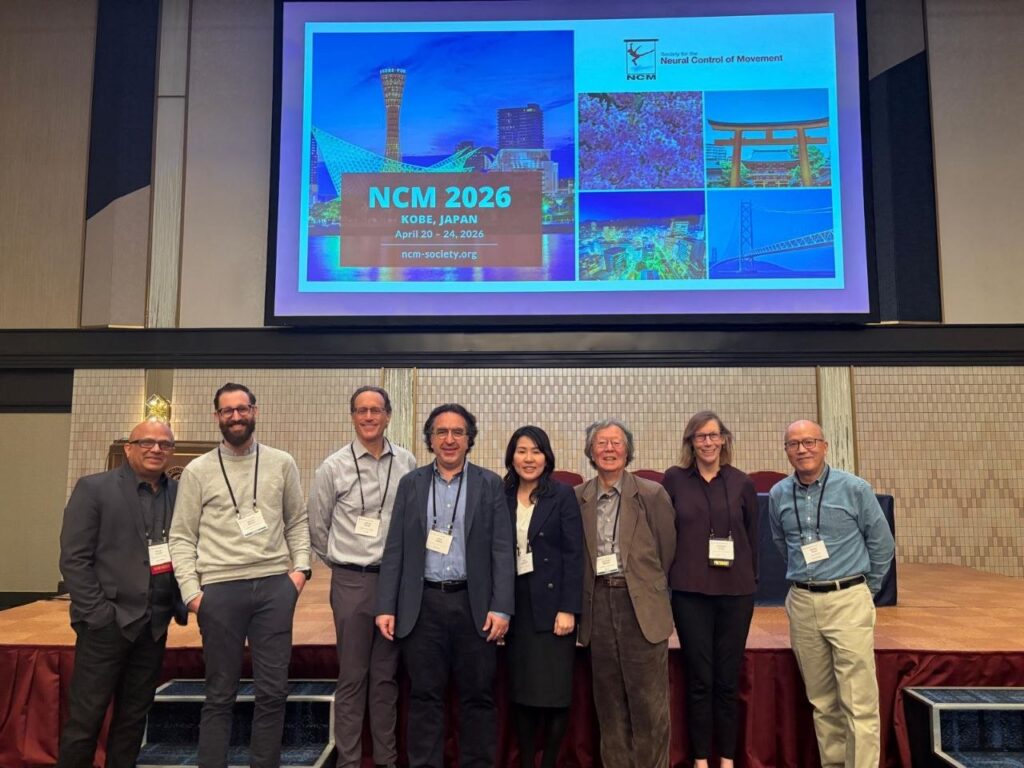
After the pre-NCM meeting in Sendai, we moved on to Kobe! We attended the 2026 Annual Meeting of the Neural Control of Movement Society.
The meeting was great, and it featured many different topics related to motor control. Some presentations included motor control in the clinics and in medical applications. Others included birdsong and prostheses.
Our lab had five posters at the meeting.
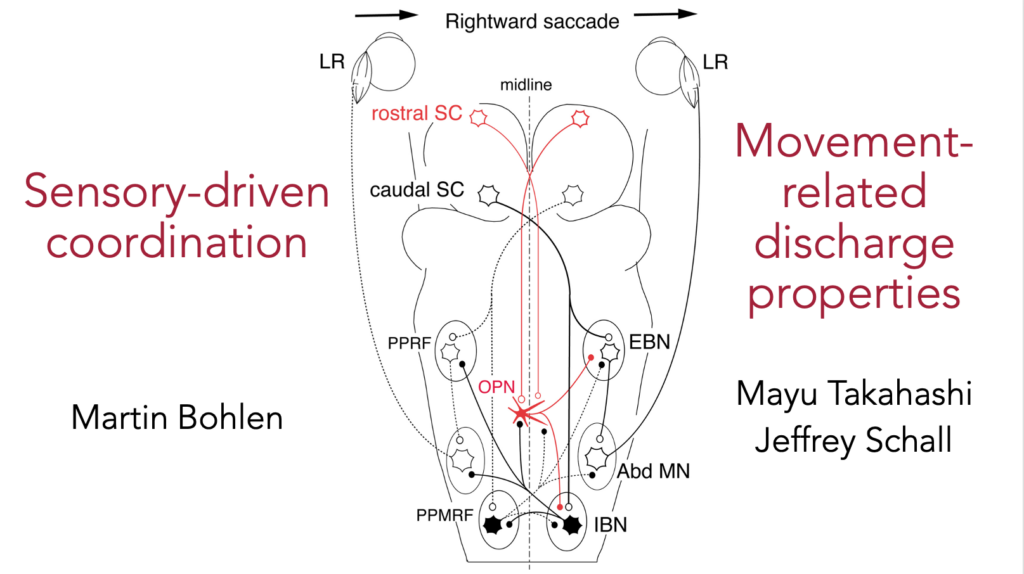
In addition, Ziad was part of a plenary session on the oculomotor system. This session included Mayu Takahashi, Jeffrey Schall, and Martin Bohlen as additional speakers, as well as Neeraj Gandhi as a discussion leader. The session was great, and it even featured a tribute to Ed Keller. This was very fitting given his seminal contributions to the understanding of brainstem circuits for eye movement control, a primary topic of the plenary session.
In his talk, Ziad spoke about how omnipause neurons (OPN’s) in the brainstem can be used to develop fundamental new understanding of not only saccade control, but also of the control of slow and small eye movements. He also argued that sensory responses in these neurons are essential for proper sensory-motor coordination when our brain is faced with exogenous stimuli coming asynchronously with respect to instantaneous internal state. Ziad’s talk thus acted as a perfect bridge between the other speakers: on the one hand, Mayu Takahashi and Jeff Schall spoke about motor aspects related to OPN’s, and on the other hand, Martin Bohlen spoke about retinal anatomical projections to the brainstem (and what they might functionally mean). Therefore, Ziad bridged all other three speakers, and he tried to show how physiology on both the motor and sensory sides of OPN’s could help to constrain the space of many functional interpretations that are afforded by anatomical connectivity studies alone.
The plenary session was perceived by the entire NCM audience as being very highly successful, and as providing novel insights for many future discoveries. We are very grateful to have contributed to this session.
Our lab’s five posters at the rest of the conference were essentially supporting materials for Ziad’s talk, and they helped to provide further details about the implications of the discoveries that he described.
We look forward to exciting publications out of the work that we have presented at this year’s NCM annual meeting!