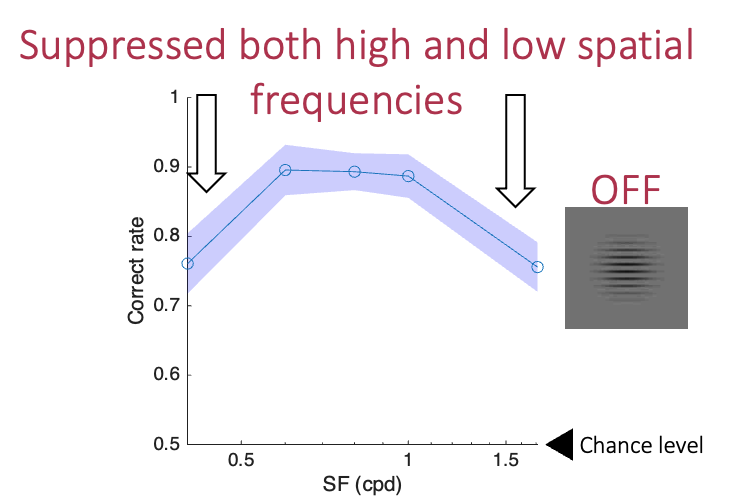
Our lab participated in a highly interesting workshop on Early Pattern Vision, which was part of the activities of our long-running Collaborative Research Center on Robust Vision.
This workshop took place in Tübingen’s Cyber Valley, and it included researchers from Spain, Switzerland, and Germany. The ranges of expertise were broad, reflecting the multi-disciplinary nature of the workshop.
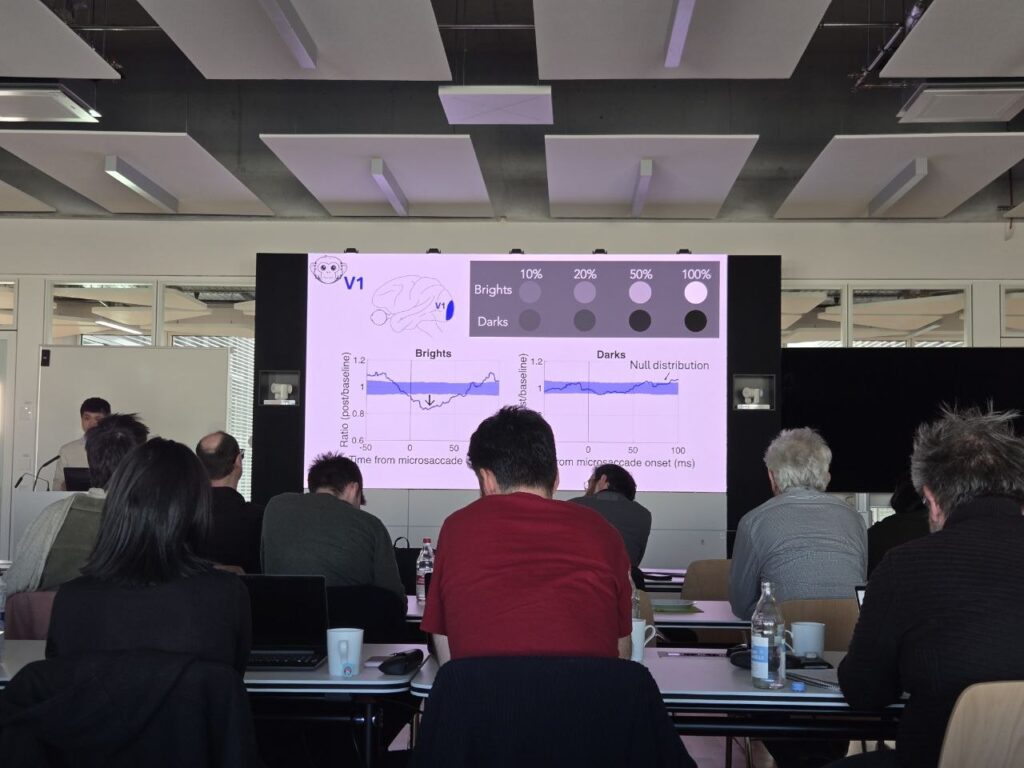
Our lab had two presentations at this workshop, both bridging neuroscience with psychophysics and computation.
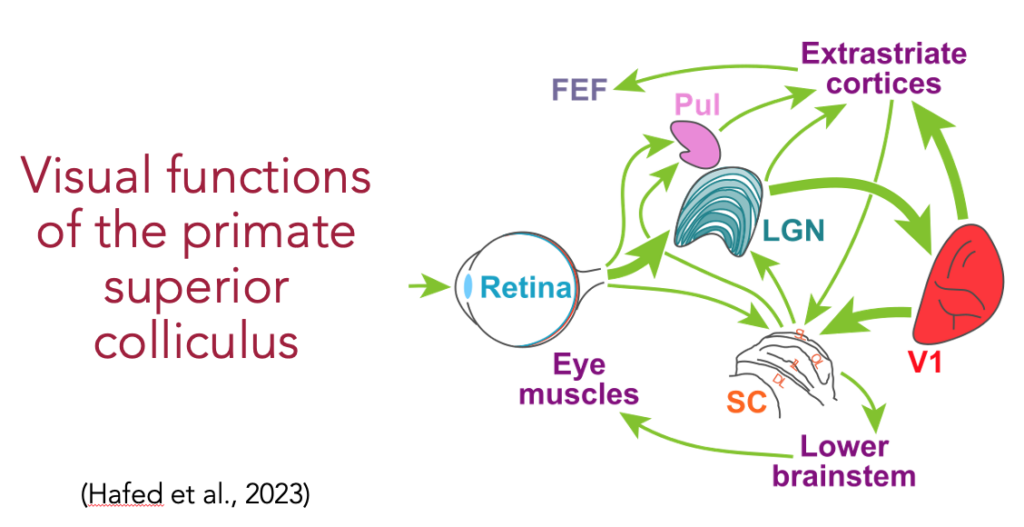
In the first presentation, Ziad described our observations of functional differences between the superior colliculus (SC) and primary visual cortex (V1) in temporally filtering dynamic natural scenes. He also explored the nature of the relationship between the SC and V1 in terms of visual function and anatomy.
In the second presentation, Wenbin gave a talk about an intriguing perceptual observation related to saccadic suppression. We and others have repeatedly observed that saccadic suppression strength can depend on spatial frequency (like here). However, we also know that this selectivity for a specific range of spatial frequencies can be easily altered and modified. In fact, even within the SC itself, some neurons might be selective for spatial frequency during saccadic suppression epochs and others not (like here). In his new work, Wenbin tried to explore how we can understand the mechanisms underlying saccadic suppression for different spatial frequencies. He first used our neuroscience observations to explore how on and off stimuli can be differentially suppressed by saccades in V1. Then, he developed a model to use this differential suppression to account for spatial frequency selectivity of saccadic suppression. Finally, he tested the limits of the model by doing psychophysics with different image manipulations. The neuroscience and psychophysics gave very intriguing results, but they need to be modeled further for us to better understand the mechanisms underlying them. Once again, he could prove that the selectivity of saccadic suppression for specific ranges of spatial frequencies could easily be modified, and that it is not a hardwired fact of visual processing around the time of saccades. This motivates further studies for understanding how pattern vision is modified under active eye movement conditions. Please stay tuned for further exciting observations by Wenbin!