Our lab has participated in this year’s annual retreat, taking place in Göttingen, of the DFG-funded SPP 2205 Evolutionary Optimization of Neuronal Processing consortium.
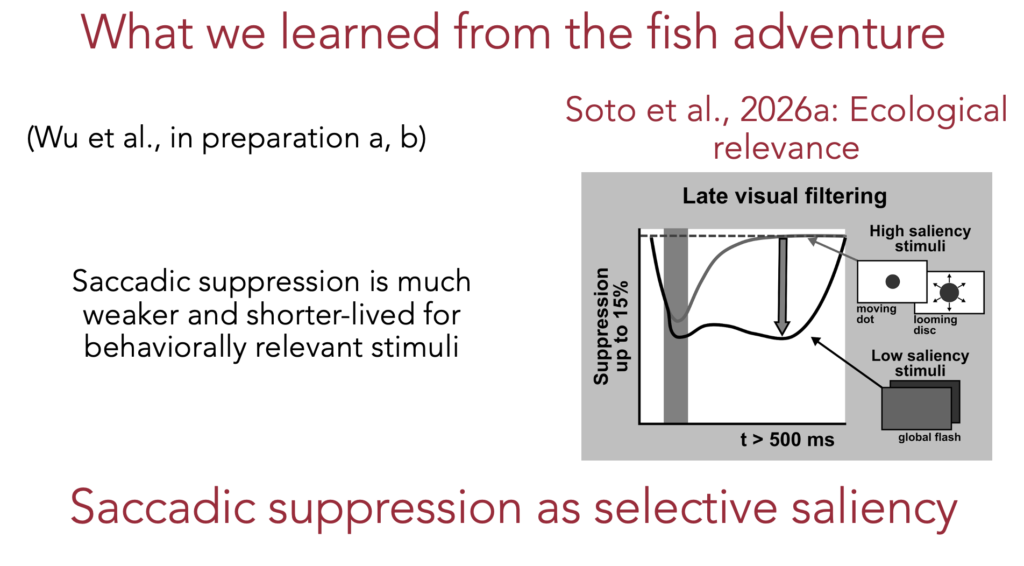
The SPP 2205 includes several research projects exploring computational constraints across a wide range of species, from insects to humans. Our lab has been active in the two funding periods of this program, by investigating saccadic suppression in both primates and zebrafish, and this has been a very fruitful collaboration with the lab of Aristides Arrenberg in our institute. As is known, saccadic suppression is the reduction in visual sensitivity if a stimulus appears near the time of a rapid eye movement. Not only did we show that saccadic suppression takes place in zebrafish, starting from their retina, but we also characterized how the computational limits and noise levels of the fish brain shape the properties of saccadic suppression. Importantly, we also found that saccadic suppression can be selective in the fish, which can enhance the relative saliency of certain types of stimuli. This idea has very intriguing correlates in primate saccadic suppression as well!
We have several exciting papers coming out of this collaboration with the Arrenberg lab, and we have used this retreat as an opportunity to highlight what we have learned so far from this line of research.
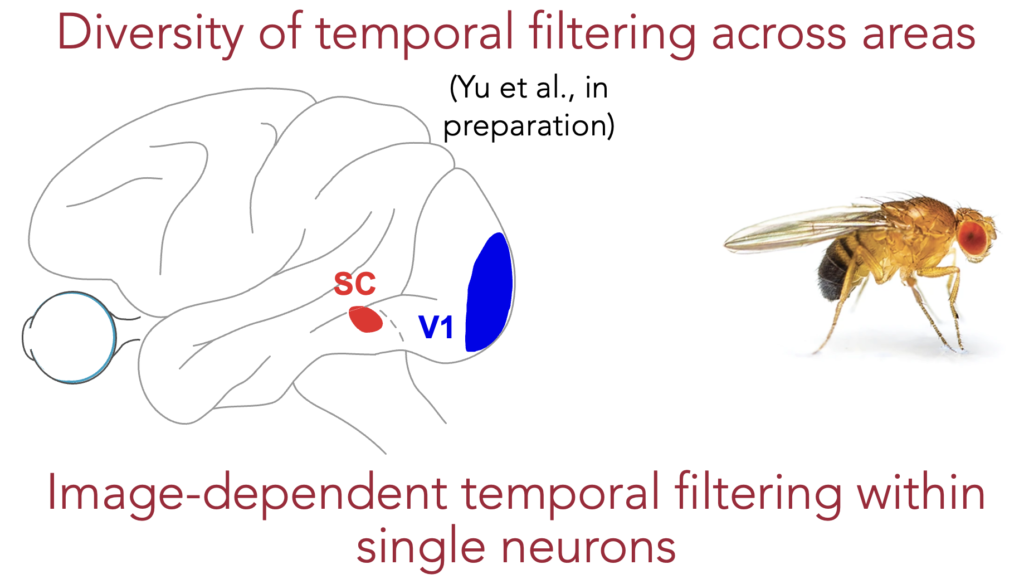
In the same spirit of the retreat, and SPP consortium in general, we also used this retreat as an opportunity to link our findings on temporal filtering in primate visual brain areas to such temporal filtering in the fly visual system. We presented work on image-dependent temporal filtering characteristics in the superior colliculus (SC) and primary visual cortex (V1) of primates, and we linked them to observations in the SPP colleagues from the fly visual system. What is remarkable is that there are highly interesting analogies between the two very different species, especially in terms of the use of efficient coding.
Therefore, for both zebrafish and flies, the comparative approach that we have taken in this SPP has been very illuminating.