Vision, sound, and motor action!

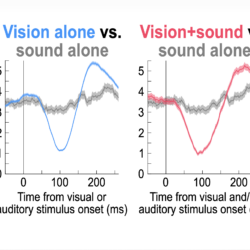
We have a new paper just published in the Journal of Neurophysiology! In it, we explored the phenomenon of saccadic inhibition from a multisensory perspective. Specifically, when a sudden visual stimulus appears in the environment, saccade generation rhythms are reflexively interrupted, and with a very short latency. One of our long term goals is to[…]


BE@ZüMüTü 2026

Our lab participated in this year’s ZüTüMü conference, which took place in Bern, Switzerland. The conference covered a wide range of topics related to perception, oculomotor control, and vestibular systems. A hallmark of the conference is that it brings together expertise from clinician scientists as well as fundamental scientists. This gives us a flavor of[…]

Society for neuroscience 2025 annual meeting

Our lab participated in this year’s Society for Neuroscience (SFN) annual meeting. We had three posters at this meeting. In the first, Tanya continued our investigations of the roles of different visual-motor pathways mediating reflexive, visually-guided behaviors. At this meeting, we characterized the activity of superior colliculus and inferior colliculus neurons during inactivation of the[…]

State estimation and sensory gating at the SPP2205 Annual Retreat (Evolutionary optimization of neuronal processing)

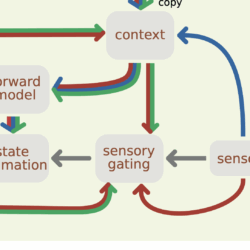
Our lab just participated in this year’s annual SPP2205 Retreat, which took place in Zeitz, Germany. The SPP2205 is a Special Priority Programme of the German Research Foundation (DFG), and it includes labs studying many different species, from insects to primates. From Tübingen, besides our lab, the labs of Jan Grewe, Jan Benda, and Aristides[…]

European Conference on Visual Perception 2025

Our lab participated in this year’s European Conference on Visual Perception! This was the 47th meeting of this annual conference, and it took place in Mainz, Germany. We had three talks at this year’s conference. In one, Ziad gave a talk about saccadic suppression in a symposium organized by David Souto and Alexander Schütz related[…]

Two summa cum laude’s in two weeks!

We are extremely proud of two PhD students from the lab, Tong Zhang and Matthias P. Baumann, who not only successfully defended their respective PhD theses during the past couple of weeks, but who also did so while each receiving the highest honors (summa cum laude)! This is a tremendous and well-deserved achievement, capping a[…]

Statistical regularities and the sensory consequences of self-action: A multi-species, multi-modal perspective

We have a new perspective article just published in Current Opinion in Neurobiology! The article is part of the 2025 Systems Neuroscience Special Issue of the journal, covering different aspects related to statistical learning in the brain. In our article, written together with our neuroscience colleagues of the University of Tübingen (Jan Benda, Jan Grewe,[…]

Gordon Conference on Eye Movements 2025

Our lab just returned from participating in this year’s Gordon Research Conference on Eye Movements. The conference took place at Mount Holyoke College in New England. We had a total of five presentations at the conference, which covered a broad range of topics related to eye movements. First, Ziad gave a feature presentation about how[…]

Foveal neurons of the superior colliculus signal trans-saccadic prediction errors | PLOS BIOLOGY

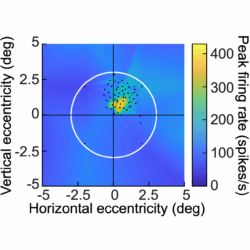
The act of foveation is a fundamental cornerstone of active vision in the human visual system, because it allows processing images with very high acuity. However, foveating eye movements pose a significant challenge in their own right. Namely, because a large number of visually-sensitive brain areas are retinotopically organized, foveal neurons in such areas experience[…]

New behavioral paradigm for testing the neurophysiological mechanisms underlying peri-saccadic visual alterations

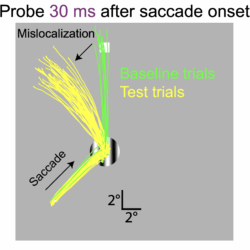
We have a new paper just published in eNeuro! In this paper, we developed a new, flexible behavioral paradigm for exploring peri-saccadic visual mislocalization in rhesus macaque monkeys. Peri-saccadic visual mislocalization refers to the phenomenon in which your percept of a stimulus flash can be strongly altered by you making a rapid eye movement. In[…]