Our lab participated in this year’s European Conference on Visual Perception! This was the 47th meeting of this annual conference, and it took place in Mainz, Germany.
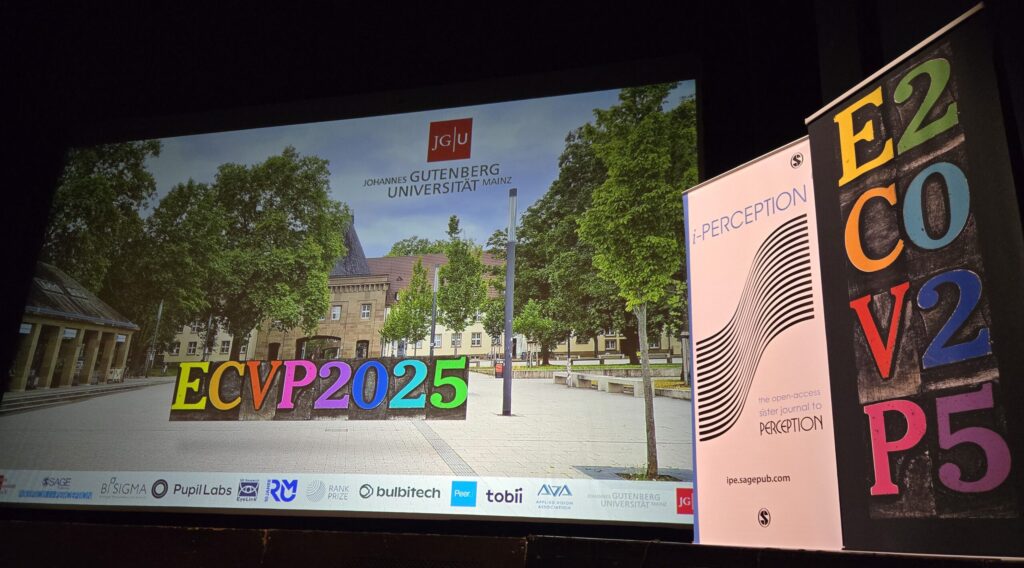
We had three talks at this year’s conference.
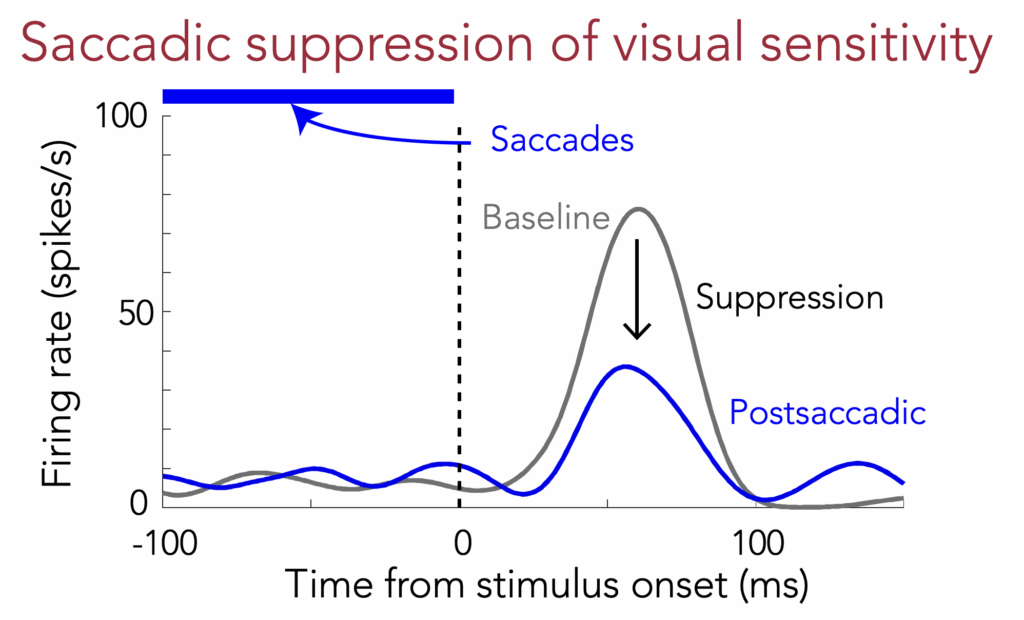
In one, Ziad gave a talk about saccadic suppression in a symposium organized by David Souto and Alexander Schütz related to the visual consequences of self actions. Ziad’s talk compared neural substrates of saccadic suppression in the primary visual cortex (V1) and the superior colliculus (SC), revealing some very interesting differences between the two brain areas. The talk also related these differences to human performance in psychophysical tasks. The symposium itself was very interesting, and it also involved studies on smooth pursuit eye movements, and even vestibular ocular reflexes.
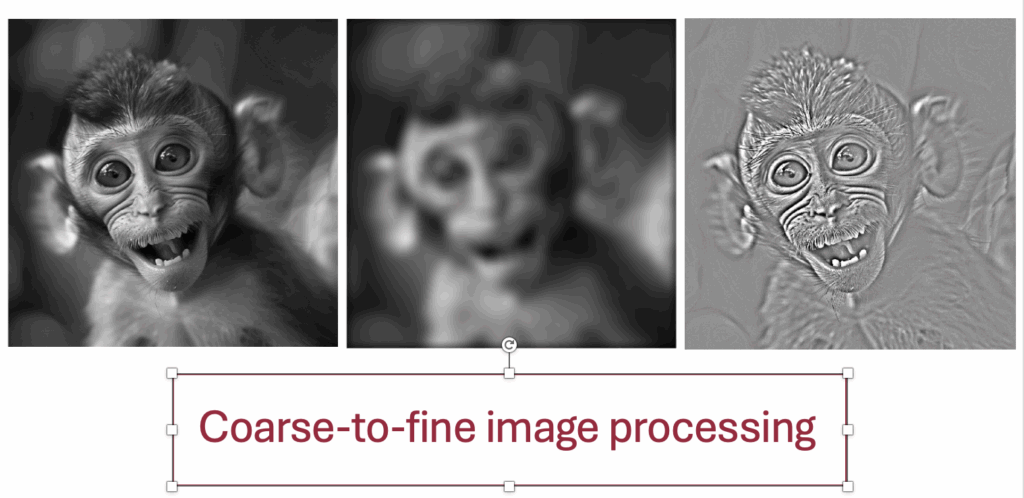
In the second talk by our lab at the conference, Yue spoke about coarse-to-fine image processing in both the SC and V1. By coarse-to-fine, it is meant that she analyzed the timing of visual responses in the two brain areas for images that are either coarse (having low-pass spatial frequency content) or fine (having high-pass spatial frequency content). She found much stronger coarse-to-fine image processing dynamics in the SC than in V1, which is very surprising at first glance. However, when one thinks about it, this result makes perfect sense because we typically employ eye movements to foveate images before visually analyzing them in the foveal parts of the retinal image. So, if the SC accelerates coarse image processing, then this also allows foveation to occur much earlier for peripheral targets, which are already generally more low- than high-pass in terms of their spatial frequency content. This result also reinforces our ideas (like here) that visual responses in the SC are not merely inherited from V1.
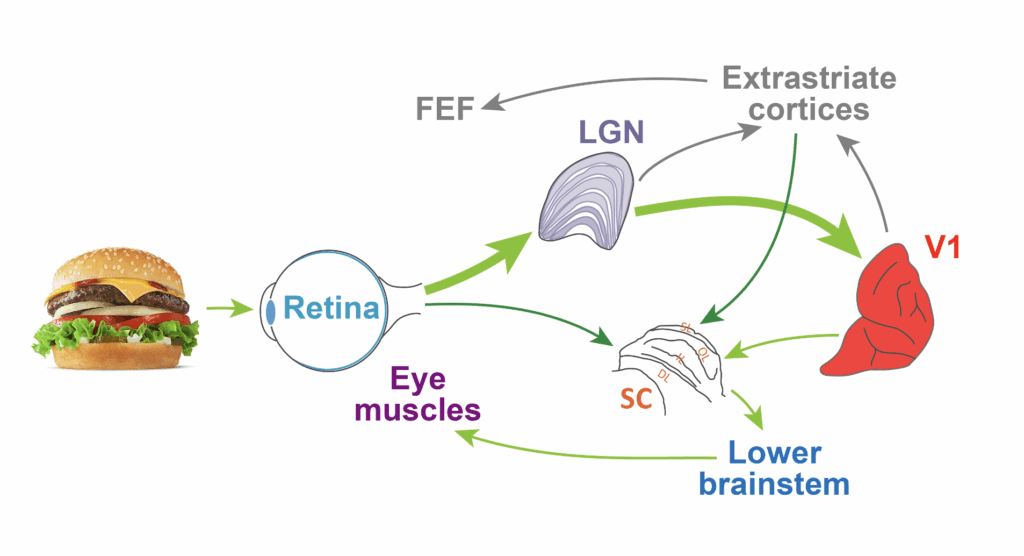
Finally, Tanya gave a talk about our investigations of the multiple processing pathways allowing rapid, reflexive visually-guided oculomotor behavior. She performed acute, reversible lesions of the primary visual cortex (V1), and she recorded neural activity from the SC and inferior colliculus (IC). She also recorded and analyzed eye movement behaviors. Her results are revealing very intriguing findings about the relative importance of the V1 pathway in relation to other projections of visual information from the retina to the oculomotor system (such as direct retino-tectal projections), and her experimental technique provides an ideal neuroscientific model system for understanding the impacts of long-term cortical lesions in human patients (e.g. for blindsight and spatial neglect clinical conditions).