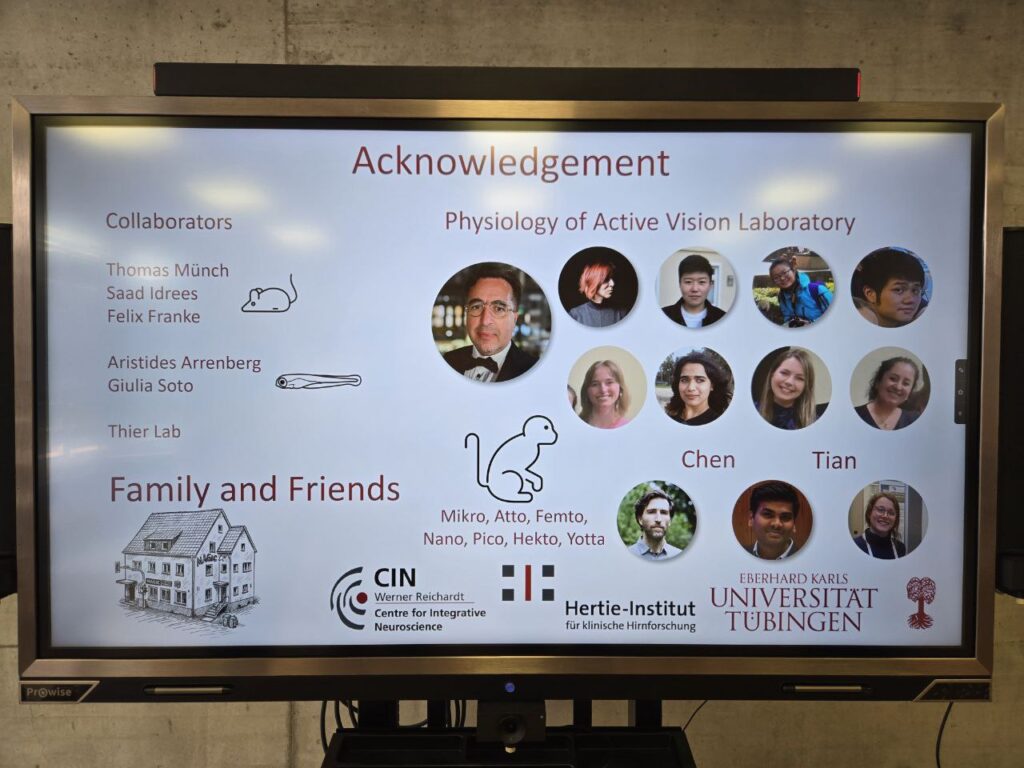
We are extremely proud of two PhD students from the lab, Tong Zhang and Matthias P. Baumann, who not only successfully defended their respective PhD theses during the past couple of weeks, but who also did so while each receiving the highest honors (summa cum laude)! This is a tremendous and well-deserved achievement, capping a highly memorable and enjoyable few years with Tong and Matthias in our lab. The amount of scientific discoveries that they each realized is simply astonishing, and testimony to their hard work and dedication.

First off was Tong. She defended a thesis titled: From the fovea to the periphery and back: mechanisms of trans-saccadic visual information transfer in the superior colliculus. This thesis included four landmark publications:
- Foveal action for the control of extrafoveal vision: This paper is very special to the lab!!! It brings closure to more than 20 years of research by Ziad since his first discovery of a link between microsaccades and covert visual attention. This discovery was later refined by Ziad in a paper in 2013, and then by Chen, Ziad, and colleagues in 2015. In both of these earlier studies, we discovered that the link between microsaccades and extrafoveal visual performance changes was much stronger than previously appreciated. However, there was always just this “one last thing” missing (not just in our lab’s prior work, but in the entire literature), which Tong succeeded in finally understanding. Amazing achievement!
- Faster detection of darks than brights by monkey superior colliculus neurons: This paper was part of our efforts to understand the visual properties of the primate superior colliculus. In it, Tong and her colleagues studied how the visual drive in the superior colliculus (SC) can contribute to orienting gaze towards the periphery.
- Superior colliculus saccade motor bursts do not dictate movement kinematics: Then, Tong turned her attention to the actual generation of saccades to the periphery. Here, she discovered something quite remarkable, which set the stage for her journey back to the fovea, as per the title of her thesis. In this paper, Tong looked at the motor commands of the SC, and she had cases in which there was a visible saccade target, and cases in which the saccade was just made to a blank. She found that the motor burst was, more often than not, very different depending on the presence of a visual saccade target. Besides setting the stage for Matthias’ subsequent spectacular discovery about the SC motor commands (see below), this led Tong to believe that, perhaps, the SC motor bursts can perform what people in the literature called “peripheral preview”. She wondered whether such a peripheral preview could help trans-saccadic integration once the new target is finally foveated. This set the stage for her final part of the journey in the thesis back towards the fovea after saccades.
- Foveal neurons of the monkey superior colliculus signal trans-saccadic prediction errors: If saccades are associated with a peripheral preview effect, then this can help foveal vision after the eye movement. That is, when you make a saccade from, say, a face in front of you to, say, the window to the side, the foveal image after the eye movement (the window) is very different from the foveal image before it (the face). However, our perception is seamless. If SC motor bursts (or other sources) take a snapshot “preview” of what to expect in the fovea after the eye movement (the window), then maybe foveal neurons of the SC can be sensitive to this. Thus, Tong recorded from foveal SC neurons and found that they signal a prediction error. When the image that they land on after the saccade is different from the image expected from the peripheral preview before the saccade, these neurons signal an inconsistency. This is a remarkable instantiation of predictive coding, now in the context of active vision.
In all, Tong covered aspects of how the fovea can influence the periphery, how the periphery can guide eye movements, how the motor generation towards the periphery can also carry a preview of the expected appearance of the saccade target in the fovea after the eye movement, and how foveal SC neurons actually benefit from such a peripheral preview to establish perceptual stability.

Then, came Matthias! He defended a thesis titled: Visual-motor neural mechanisms underlying peri-saccadic perceptual alterations. This thesis included five publications, which are absolutely among the most significant publications in the entire history of our lab:
- Perceptual saccadic suppression starts in the retina: Where to begin? This paper has so many gems in it! Among them, Matthias showed that perceptual saccadic suppression has a surprisingly strong and early visual origin. In this phenomenon, if we flash a brief visual stimulus around the time of saccade onset, visual sensitivity is strongly reduced. In this work, Matthias and Saad Idrees showed that this already starts in the retina. Importantly, the dependence of perceptual suppression on different visual image properties was perfectly matched to how the retina behaved. So, the visual properties of perceptual saccadic suppression are dictated already in the very first stage of visual processing in our bodies. Then, Matthias showed that extra-retinal mechanisms, such as internal knowledge of the saccade motor command, actually act in an opposite way from what was assumed in the literature. It was always assumed that internal knowledge of the saccade motor command, commonly described as efference copy or corollary discharge, acts to suppress visual sensitivity in neurons. However, Matthias showed that the reality might be the exact opposite. The extra-retinal motor command processes associated with saccadic suppression may involve gain enhancement, in order to shorten and alleviate the massively strong retinal suppression. Finally, and most importantly in our view, Matthias revisited a very classic phenomenon in the literature, which was a poster child for extra-retinal origins of perceptual saccadic suppression. In this phenomenon, saccadic suppression was shown to be selective for low spatial frequencies (coarse visual image textures). In an amazing series of experiments with real and simulated saccades, Matthias showed that this selectivity of suppression to low spatial frequencies is completely independent of extra-retinal motor commands! Even more strikingly, he showed that it is very easy to break this selectivity property with simple changes in the visual context of the scene! Thus, with or without saccades, selective suppression may or may not happen. This is a very striking result, and it has set the stage for exciting ongoing experiments in our lab.
- Dependence of perceptual saccadic suppression on peri-saccadic image flow properties and luminance contrast polarity: Having established the visual origin of saccadic suppression, Matthias then went to explore additional features of it. He looked at things like background luminance and also whether the flashes presented peri-saccadically were brighter or darker than the background. He, again, established a strong visual origin of saccadic suppression. Importantly, his work on luminance polarity (brighter or darker than the background) and saccadic suppression was a nice way to link Tong’s work above (about luminance polarity). That is, his work could now act as a bridge with Tong’s work, to try to link two topics (luminance polarity and saccadic suppression) together. This link is now an active part of the projects in our lab, and we have very intriguing observations on dark and bright saccadic suppression, and how they might be similar or different in the SC and the primary visual cortex.
- Sensory tuning in neuronal movement commands: The above work left Matthias in a situation where he really had to revisit the question of extra-retinal mechanisms more seriously. So, he now focused on motor commands of the SC. These are a known source of corollary discharge for peri-saccadic perceptual alterations. However, the concept of corollary discharge was almost overwhelmingly confined to the idea that it allows spatial updating of retinotopic representations. That is, the SC motor corollary tells the visual system about the direction and amplitude of the upcoming saccade, in order to update retinotopic representations after the eyeball rotation. However, what if the role of corollary discharge was broader? What if there is a visual signal embedded in it? This visual signal would be exactly what is needed for Tong’s foveal neurons above to have the peripheral preview benefit mentioned above. So, Matthias looked at SC motor bursts for the very same saccades but different images as the targets of the saccades. This gave a truly astonishing result: SC motor bursts are “visually” tuned! The very same saccade to one image gives a different SC motor burst in one neuron than if the image was different. Thus, the SC motor bursts can embed within them a peripheral preview, which can be critical for trans-saccadic perception. The corollary discharge from the SC does not need to be restricted to indicating the size and direction of an upcoming saccade (useful for spatial updating of retinotopic maps across eye movements); rather, it can provide a visual feature preview critical for trans-saccadic integration and perceptual stability.
- Perisaccadic perceptual mislocalization strength depends on the visual appearance of saccade targets: To provide a link between the above discovery and perception, Matthias now returned to human perception. Specifically, SC corollary discharge is thought to be associated with updating of retinotopic spatial representations like mentioned above. Such updating is also thought to have a correlate in a perceptual illusion called perisaccadic mislocalization. So, Matthias hypothesized that if the SC motor commands are sensory-tuned, then this illusion should indeed depend on the visual appearance of the saccade target, which he confirmed.
- Two-dimensional perisaccadic visual mislocalization in rhesus macaque monkeys: Finally, Matthias wanted to create a foundation for studying neurophysiological mechanisms of perisaccadic mislocalization. To date, there has never been a truly matched monkey paradigm to the human experiments, which precluded doing exact experiments as with humans for neurophysiological investigations. Thus, Matthias created a highly flexible and robust perisaccadic mislocalization paradigm in monkeys (demo movie here). He then went on to prove its utility by showing that monkeys directly replicated a clear property of such mislocalization in humans, which we had previously documented in the literature. Therefore, we are now in a perfect position to investigate the neural basis for this property, and others, to truly advance the field of perceptual stability and active vision.
In all, Matthias had an exhaustive look at classic phenomena in active vision, providing a decidedly fresh perspective on them.
Both Tong and Matthias were also actively involved in many other collaborative projects in the lab, and we expect a lot more exciting work from them in the near future. Please keep an eye out at our Publications page to see their contributions, as well as those of the other lab members, to the scientific literature on active perception!