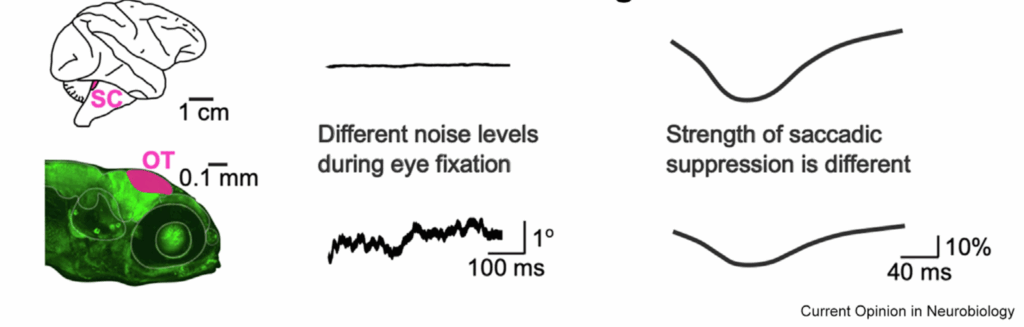
We have a new perspective article just published in Current Opinion in Neurobiology! The article is part of the 2025 Systems Neuroscience Special Issue of the journal, covering different aspects related to statistical learning in the brain.
In our article, written together with our neuroscience colleagues of the University of Tübingen (Jan Benda, Jan Grewe, Cornelius Schwarz, and Aristides Arrenberg), we focused on the question of how the brain handles the sensory consequences of self-action. That is, every time the brain generates a “motor” output, whether it be an electric discharge in fish or a whisking movement in mice or an eye movement in humans, the sensory environment of the brain is itself altered. For example, moving the eye generates a movie on the retina even if the visual scene is completely static. Thus, being an active organism requires being able to differentiate sensory inputs that are a consequence of one’s own self-action from those that are genuine events (like a flashing traffic light) in the environment. In our article, we argued that the brain exploits learning in order to handle the sensory consequences of self-action, and we reviewed evidence of how statistical regularities associated with self-action (as well as the environment itself) are a very useful cue for differentiating between self-generated and exogenous sensory events. Moreover, we argued that similar principles govern vastly different organisms, possessing very different computational constraints in the central nervous system, and also vastly different time scales of self-action. Indeed, even within a single modality, such as eye movements in humans, the brain needs to handle not only rapid saccades, lasting for only about 50 ms, but it also needs to process slower eye movements that can go on for several seconds on end.
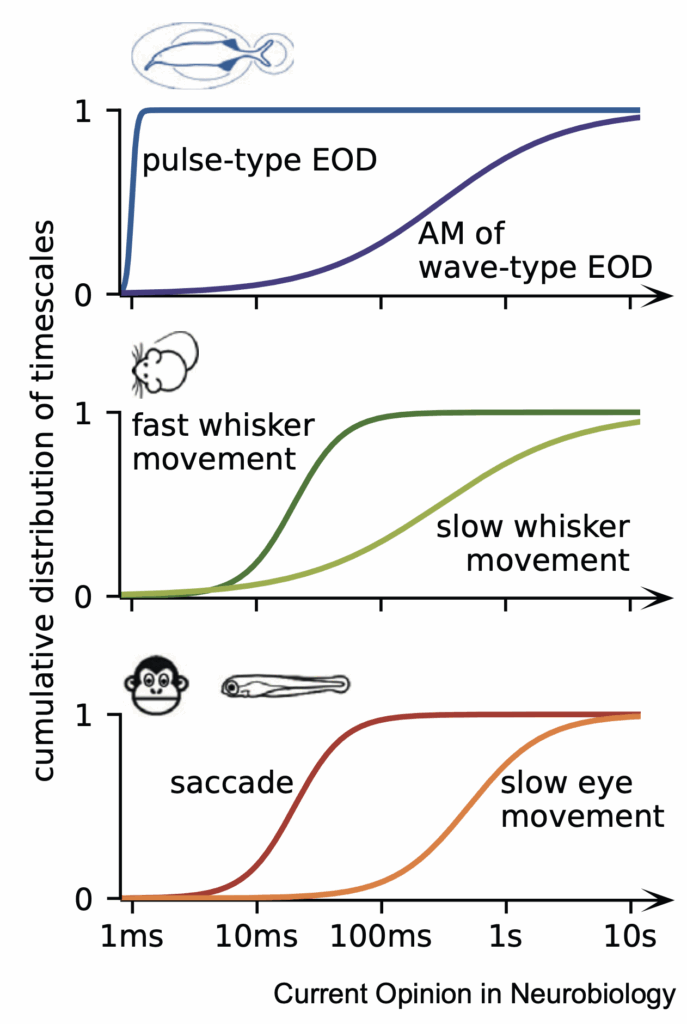
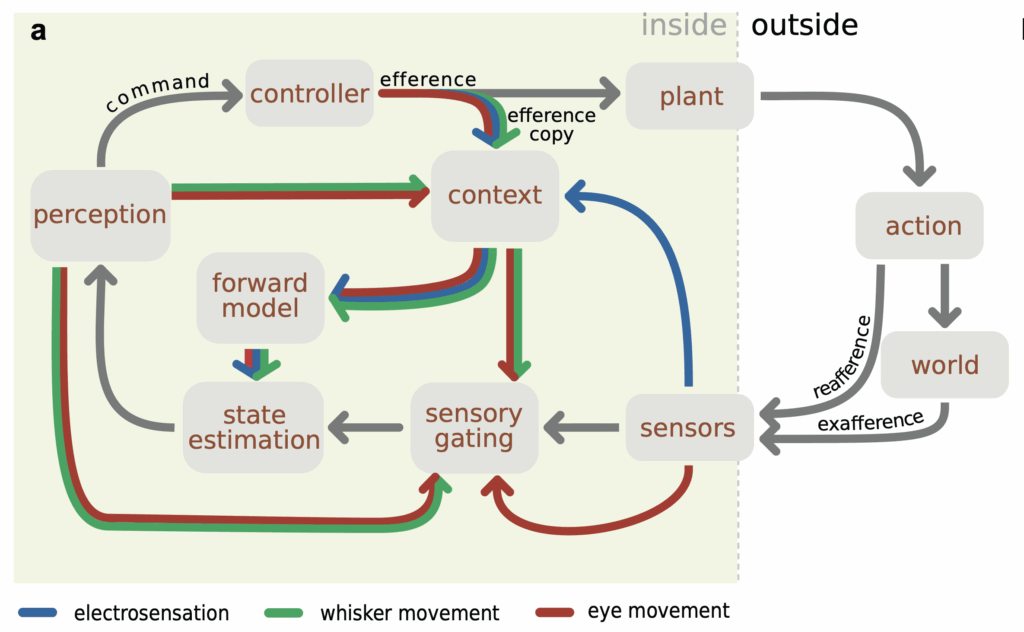
In our article, we delineated between two distinct, but related, phenomena: sensory gating and state estimation. By sensory gating, we meant the modulation of sensitivity to exogenous sensory events that happen to occur around the time of self-action. For example, our prior work on saccadic suppression would fall into this category. For state estimation, this is the process of internally inferring whether sensory inputs are due to exogenous environmental events or whether they are consequences of self-action. For example, when making a rapid saccade across a static seen, we do not experience the brief retinal movie caused by rapid eyeball rotation, and this is a perceptual outcome of state estimation. In our article, we described how electrosensory processing in fish, haptic touch through whisking in mice, and eye movements in primates and fish are all associated with processes of sensory gating and state estimation. We also explained how implicit learning of the statistical regularities of the environment and the self-actions in all of these species and modalities contribute to both processes.
The best thing about this article, in our minds, is that it has widened our own perspective when thinking about phenomena that we had been studying in our lab for many years. This was truly an eye opening experience, and it has allowed us to already think of new interesting collaborations with our colleagues. For example, given this article, we have developed fresh new perspectives on the possibility of the existence of saccadic suppression in the zebrafish retina and optic tectum, and also on comparative studies between zebrafish and primates using matched visual stimuli and experimental paradigms. Stay tuned for more exciting results in this space!